Landscape Material Guide
How Much Does a Cubic Yard of Sand Weigh?
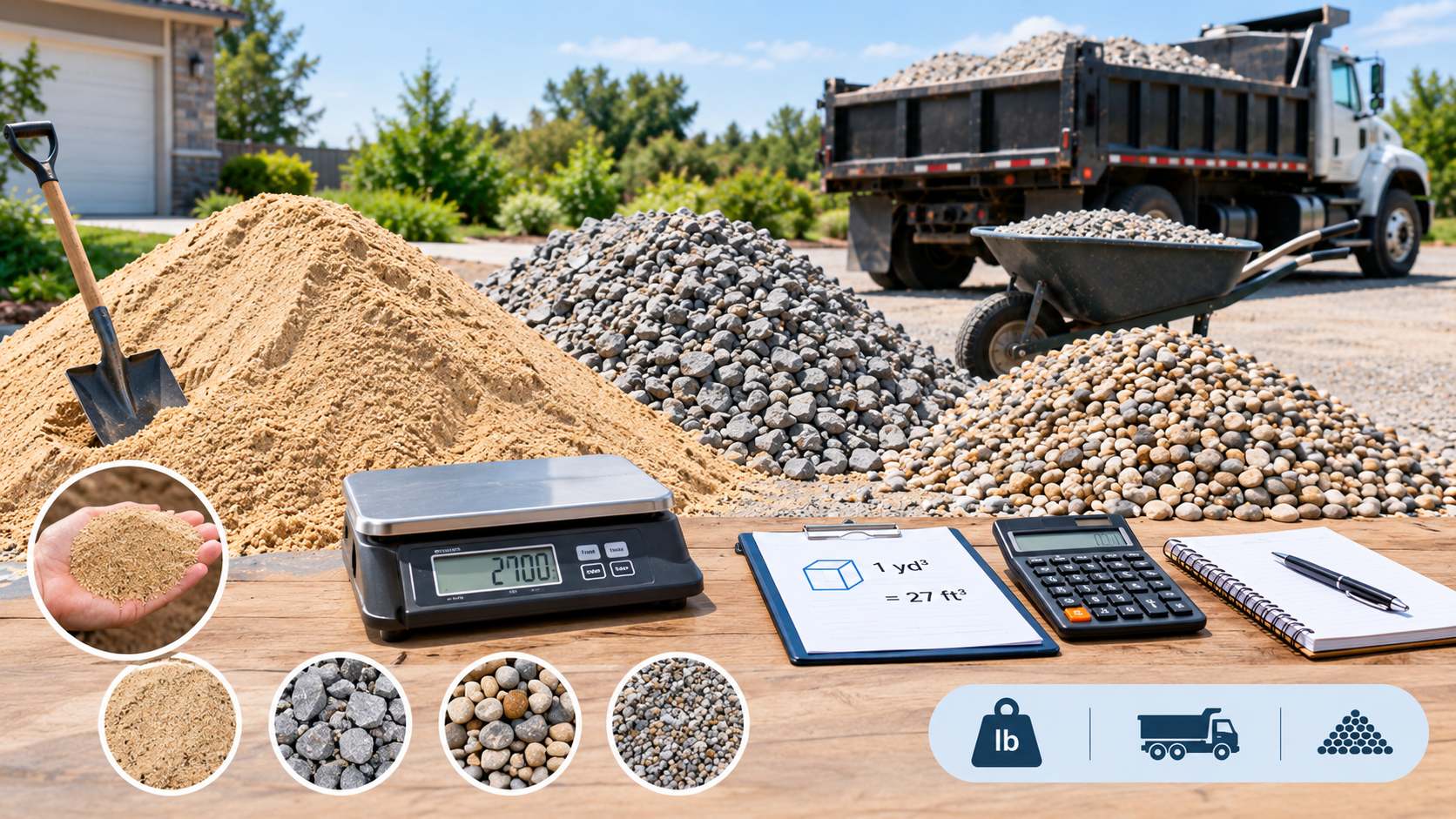
A cubic yard of dry sand weighs approximately 2,700 pounds, or 1.35 US short tons, when using a representative bulk density of 100 pounds per cubic foot. The actual weight depends on the type of sand, moisture content, and how densely the material is packed. Use these estimates to plan construction projects, arrange deliveries, and calculate material quantities.
Quick Answer
How much does a cubic yard of sand weigh?
A cubic yard of dry sand weighs approximately 2,700 pounds, equal to 1.35 US short tons, when using an assumed bulk density of 100 pounds per cubic foot. Actual weight varies according to the type of sand, moisture content, and how the material is packed.
One cubic yard contains 27 cubic feet. To estimate the weight, multiply the volume by the material's bulk density. For landscaping projects involving pea gravel, use the Nerdds Pea Gravel Calculator to estimate the volume required for your project.
How Much Does 1 Yard of Sand Weigh?
One cubic yard of sand contains 27 cubic feet. The weight depends on the bulk density of the material. For example, if the sand has an assumed bulk density of 100 pounds per cubic foot, the calculation is:
The following table shows how different assumed bulk densities affect the estimated weight of one cubic yard of sand.
| Assumed bulk density | Weight per cubic yard | US short tons |
|---|---|---|
| 90 lb/ft³ | 2,430 lb | 1.215 tons |
| 100 lb/ft³ | 2,700 lb | 1.35 tons |
| 110 lb/ft³ | 2,970 lb | 1.485 tons |
These are mathematical estimates based on the listed densities, not guaranteed weights for every sand product. Ask your supplier for the bulk-density information of the material you intend to purchase, particularly when planning a large delivery or transportation load.
How Much Does a Cubic Yard of Sand Weigh When Wet?
Wet sand generally weighs more than dry sand because the water adds mass. However, the exact difference depends on how much moisture the sand contains and how its volume is measured.
For example, suppose a cubic yard of sand has a dry-equivalent weight of 2,700 pounds. If the retained water adds another 270 pounds, the total estimated weight becomes:
Sand stored outdoors may contain different amounts of moisture after rainfall or exposure to damp conditions. A dry-weight estimate may therefore differ from the actual weight of a delivered load.
When arranging transportation, ask the supplier for the expected delivered weight and check that your vehicle or trailer can safely carry the load. Include passengers, tools, and other cargo when checking the permitted payload.
Does Sand Type Affect Its Weight?
Yes. Sand products vary in mineral composition, grain size, grading, moisture content, and bulk density. Their weights can differ even when they occupy the same measured volume.
| Sand type | Typical application | What to consider |
|---|---|---|
| Play sand | Sandboxes and children's play areas | Check product specifications and moisture condition. |
| Masonry sand | Mortar and masonry work | Confirm the specified grade and intended use. |
| Concrete sand | Concrete and construction applications | Follow the mix or project specification. |
| Fill sand | Filling and ground grading | Density and moisture affect quantity and compaction. |
| Bedding sand | Bedding beneath suitable paving systems | Follow the installation specification. |
These categories describe common applications, not interchangeable material specifications. Choose sand according to your project's requirements rather than weight alone. When estimating material quantities, use a density that matches the actual product and its delivery condition.
How to Calculate the Weight of a Cubic Yard of Sand
You can estimate sand weight when you know the volume and bulk density. If the volume is measured in cubic feet and density is expressed in pounds per cubic foot, multiply the two values to calculate the weight in pounds.
Since one cubic yard equals 27 cubic feet, convert cubic yards to cubic feet before applying a density expressed in lb/ft³.
Example: Calculate the weight of 3 cubic yards of sand
Assume the sand has a bulk density of 100 pounds per cubic foot. Follow these steps to calculate the estimated weight of 3 cubic yards.
Convert to cubic feet
Multiply the volume by 27: 3 × 27 = 81 cubic feet.
Calculate the weight
Multiply the volume by the assumed density: 81 × 100 = 8,100 pounds.
Convert to tons
Divide by 2,000: 8,100 ÷ 2,000 = 4.05 US short tons.
The estimated weight of 3 cubic yards of sand is 8,100 pounds, or 4.05 US short tons. This example assumes a consistent bulk density of 100 pounds per cubic foot. Actual weights can differ when moisture, grading, and packing conditions vary.
How Much Does Half a Yard of Sand Weigh?
Half a cubic yard contains 13.5 cubic feet. Using the same assumed bulk density of 100 pounds per cubic foot, the estimated weight is:
The following table shows the calculation using different assumed densities.
| Assumed bulk density | Weight of half a cubic yard | US short tons |
|---|---|---|
| 90 lb/ft³ | 1,215 lb | 0.6075 tons |
| 100 lb/ft³ | 1,350 lb | 0.675 tons |
| 110 lb/ft³ | 1,485 lb | 0.7425 tons |
Always check your vehicle's payload rating before collecting sand. The weight of the material, passengers, equipment, and any other cargo must remain within the vehicle's permitted limits.
How to Estimate the Sand Needed for a Project
Before ordering sand for a landscaping or construction project, calculate the volume of the area you need to fill. For a rectangular area, multiply the length by the width and the required depth.
For example, consider a rectangular area measuring 10 feet long, 8 feet wide, and 3 inches deep.
Convert the depth
Divide 3 inches by 12 to convert it to feet: 3 ÷ 12 = 0.25 feet.
Calculate cubic feet
Multiply length, width, and depth: 10 × 8 × 0.25 = 20 cubic feet.
Convert to cubic yards
Divide by 27: 20 ÷ 27 ≈ 0.74 cubic yards.
The theoretical volume required is approximately 0.74 cubic yards before allowing for uneven ground, compaction, settling, or other project-specific adjustments.
If your landscaping project uses pea gravel instead of sand, the Pea Gravel Calculator can help estimate the volume needed for your surface area and selected depth. If your project uses both sand and gravel, calculate each material separately because their bulk densities may differ.
Nerdds Landscape Calculator
Calculate How Much Pea Gravel You Need
Estimate the gravel volume required for a walkway, patio, garden bed, or other landscaping project. Enter your measurements and selected depth to plan the quantity before ordering materials.
Open Pea Gravel Calculator →Frequently Asked Questions
How many pounds is a yard of sand?
Using a representative density of 100 pounds per cubic foot, one cubic yard of sand weighs approximately 2,700 pounds. The actual weight depends on the material's bulk density, moisture content, and packing.
How many tons is a cubic yard of sand?
At an estimated weight of 2,700 pounds, a cubic yard of sand equals 1.35 US short tons because one US short ton equals 2,000 pounds. The same weight is approximately 1.225 metric tonnes. Actual weight depends on the sand and its condition.
Does compacted sand weigh more per cubic yard?
Compaction can increase the mass of sand occupying a given volume because it reduces the air space between particles. However, the total mass of the same amount of sand does not increase simply because it is compacted. Make sure your density estimate matches the material's condition and the volume measurement being used.
Is a cubic yard of sand heavier than a cubic yard of gravel?
Not necessarily. Their relative weights depend on the specific sand and gravel products, bulk densities, moisture content, and packing. Use material-specific density estimates rather than assuming one material is always heavier than the other.
Estimate Material Quantities Before Ordering
The weight of a cubic yard of sand depends on its bulk density and condition. Use a clearly stated density assumption for preliminary calculations, then confirm the supplier's specifications before arranging delivery or transportation.
If you are comparing different landscaping materials, you can also read our guide on gravel weight per cubic yard to understand how the estimated weight of gravel compares with sand. For material budgeting, see our guide to gravel prices per ton when comparing aggregate costs.
Nerdds Landscape Tools
Estimate Your Landscaping Material Requirements
Calculate the volume needed for your project, compare material requirements, and confirm bulk-density estimates before ordering. Check supplier specifications and vehicle payload limits when planning a delivery or collecting materials yourself.
Calculate Gravel Volume →