Pool Maintenance Guide
Pool Test Kit for Saltwater Pools: How to Test Salt Levels
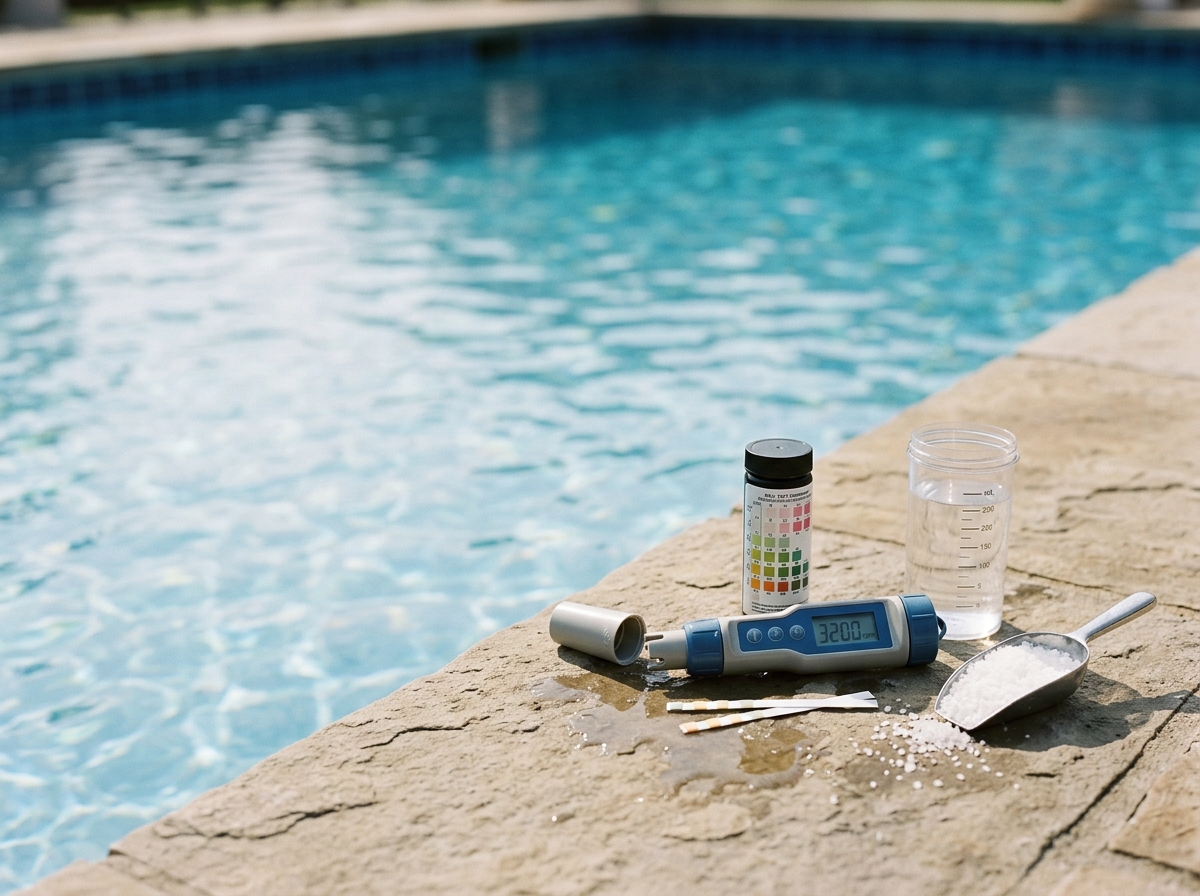
A reliable pool test kit for saltwater pools helps you monitor salinity, keep your salt chlorine generator operating within its recommended range, and avoid adding more salt than your pool needs. Whether you use a digital pool salinity tester, a salt test kit, or a saltwater pool test system, accurate readings are essential for maintaining balanced pool water.
Quick Answer
How do you test salt levels in a saltwater pool?
You can measure pool salinity using a digital pool salinity tester, salt test strips, a drop-based salt test kit, or a suitable independent testing method. Some salt chlorine generators also display an estimated salt level.
The right testing method depends on your equipment, how frequently you test, and how precisely you need to measure salt concentration. Once you know your current salt level, use the Nerdds Pool Salt Calculator to estimate how much salt is needed to reach your target.
Pool Salt Calculator
Already tested your pool water? Use your salt reading to calculate the amount of pool salt needed.
The Nerdds Pool Salt Calculator estimates the required salt based on your pool volume, current salinity, target salinity, and salt bag size. It provides the estimated amount in pounds and kilograms, along with the number of bags to purchase.
To get started, have these details ready:
- Pool volume: The total amount of water in your swimming pool.
- Current salt level: Your latest salt test result in parts per million (ppm).
- Target salt level: The level recommended for your salt chlorine generator.
- Salt bag size: The weight of each bag you intend to use.
Use an actual test reading rather than guessing your pool's salinity. Always confirm the target level in your salt system's manufacturer's instructions before adding salt.
Nerdds Calculator
Calculate How Much Pool Salt You Need
Enter your pool volume, current salt level, target salinity, and bag size to estimate the amount of salt required.
Open Pool Salt Calculator →What Is a Pool Test Kit for Saltwater Pools?
A pool test kit for saltwater pools measures the concentration of dissolved salt in your swimming pool. Saltwater pools use a salt chlorine generator, also called a saltwater chlorinator, to convert dissolved sodium chloride into chlorine that sanitizes the water.
The generator requires an appropriate salt concentration to operate correctly. If the level falls below its recommended range, chlorine production may decrease or the system may display a low-salt warning. Excessively high salinity can also trigger equipment warnings and may contribute to corrosion concerns, depending on the system and surrounding materials.
A swimming pool salt tester helps you check salinity before making adjustments. Some testing products measure salt specifically, while others measure several water chemistry parameters, such as pH, free chlorine, total alkalinity, and calcium hardness.
A salt test alone does not confirm that pool water is properly sanitized. You must also monitor chlorine and other relevant water chemistry readings.
Types of Saltwater Pool Test Kits and Salt Testers
There are several ways to measure the salt concentration in a swimming pool. The best choice depends on your budget, preferred testing method, and the precision required by your pool equipment.
Digital Pool Salinity Tester
A digital pool salinity tester measures the water's salinity electronically and displays a numerical result, commonly in ppm. Many models use electrical conductivity to estimate salt concentration.
Digital salt testers are useful for pool owners who want quick readings without interpreting a color chart. They can also make it easier to compare readings over time.
Advantages- Provides a numerical salt reading.
- Usually offers quick measurements.
- Convenient for regular pool maintenance.
- Makes it easier to record and compare results.
- Requires proper calibration or verification according to the manufacturer's instructions.
- Battery replacement or maintenance may be necessary.
- Accuracy varies by model and testing conditions.
- Some meters measure general conductivity rather than sodium chloride specifically, so confirm that the product is designed for pool salinity.
A digital salt meter for pools is a practical choice if you test frequently and prefer numerical results.
Saltwater Pool Test Strips
Salt test strips are a simple option for measuring pool salinity. Depending on the product, you dip a strip into a water sample and compare the resulting color with the manufacturer's chart.
Some swimming pool test strips measure salt alone, while others include several water chemistry tests. Always check the package to confirm that salt measurement is included.
Advantages- Simple to use.
- Usually inexpensive per test.
- Easy to store and carry.
- No electronic meter required.
- Results may be less precise than those from a suitable digital meter or titration-based test.
- Color interpretation can be subjective.
- Expired or improperly stored strips may produce unreliable results.
- Different products have different measurement ranges.
Follow the specific product instructions for sample collection, waiting time, and result interpretation.
Drop-Based Salt Test Kits
A drop-based salt test kit measures salinity through a chemical reaction, often using a titration procedure. You add the specified reagents to a measured water sample and determine the salt concentration according to the kit instructions.
These kits can be useful when you want a chemical test rather than an electronic measurement. The result depends on following the procedure carefully and reading the endpoint correctly.
Before purchasing, check the kit's measurement range, resolution, and suitability for your pool's expected salinity.
Electronic Pool Water Testers
An electronic swimming pool tester may measure multiple water chemistry parameters, depending on the model. These devices can be useful for broader pool maintenance, but not every electronic pool tester measures salinity.
If your main goal is to check a saltwater pool, verify that the product specifically supports salt or salinity measurements. A pH-only electronic tester will not tell you how much salt is dissolved in the water.
Salt Chlorine Generator Readings
Many salt chlorine generators display an estimated salt level or indicate whether the salinity is within the operating range.
This reading is convenient, but it should not automatically replace independent testing. Sensor condition, water temperature, calibration, and equipment-specific factors can affect the displayed value.
If the generator reading conflicts with a separate test, follow the manufacturer's troubleshooting procedure and verify the salinity with a suitable independent method before adding salt.
What Salt Level Should a Saltwater Pool Have?
The correct salt level depends on the salt chlorine generator installed in your pool. Many residential systems operate in the general range of approximately 2,500–4,500 ppm, but this is not a universal target.
Some systems specify a target around 3,000–3,200 ppm, while others require a higher concentration. The operating range and ideal target can differ even between products from different manufacturers.
Use your equipment manual as the primary reference rather than relying on a generic pool salt chart.
| Salt reading | What it may mean | Recommended next step |
|---|---|---|
| Below the manufacturer's minimum | The generator may produce less chlorine or show a low-salt warning. | Confirm the reading and calculate any required salt addition. |
| Within the recommended range | Salinity may be suitable for the system. | Continue routine water testing and maintenance. |
| Above the manufacturer's maximum | The generator may show a high-salt warning or stop operating normally. | Verify the result and follow the manufacturer's guidance before correcting it. |
A reading outside the recommended range does not always mean you should immediately add or remove salt. First, confirm the result and check the requirements for your specific equipment.
How to Choose the Best Pool Test Kit for Saltwater Pools
The best pool test kit depends on what you need to measure, how often you test, and how you prefer to interpret results.
Consider these factors when comparing saltwater pool test kits.
Measurement range and resolution
Check whether the tester covers the salinity range required by your salt chlorine generator. Resolution describes the smallest displayed or reported increment; it is not the same as accuracy.
A tester that displays more digits is not necessarily more accurate. Look for documented accuracy and a suitable measurement range.
Testing method
Choose between digital meters, salt test strips, and drop-based kits based on your preference for convenience, cost, and result interpretation.
Digital meters are convenient for numerical readings, while strips and chemical kits offer alternatives without relying on an electronic display.
Ease of use
Consider how long a test takes, whether reagents are required, how easy the result is to read, and whether the product needs regular calibration.
Maintenance and replacement costs
A digital tester may need batteries, cleaning, calibration, or occasional replacement. Test strips and reagent-based kits need consumables that can expire or require replacement.
Compare the total cost of routine testing rather than looking only at the initial purchase price.
Compatibility with your pool system
Make sure the tester measures sodium chloride salinity in a range appropriate for your saltwater pool. A general conductivity meter or pH tester may not provide the specific result you need.
Independent verification
Consider how you will confirm an unexpected result, especially before making a large salt adjustment. A second suitable testing method can help resolve uncertainty when readings disagree.
Salt Tester vs. General Pool Water Test Kit
A salt tester and a general pool water test kit serve related but different purposes.
| Feature | Salt tester | General pool water test kit |
|---|---|---|
| Main purpose | Measures salinity | Measures one or more water chemistry parameters |
| Typical result | Salt concentration in ppm or another specified unit | Values such as pH, chlorine, alkalinity, or hardness |
| Most useful for | Checking whether the salt level suits the generator | Monitoring broader water balance and sanitation |
| Important limitation | Does not necessarily measure chlorine or pH | May not include a salt test |
Some products combine several testing functions, but you should verify the included measurements before buying.
For a saltwater pool, the most useful setup is one that lets you check salinity and independently monitor the water chemistry required for safe sanitation and equipment maintenance.
How Often Should You Test Saltwater Pool Levels?
Testing frequency depends on your pool's condition, the season, recent water changes, and the manufacturer's instructions.
Consider checking salinity:
- When opening the pool for the season.
- Before adding salt.
- After a significant water replacement or dilution.
- After heavy rain or substantial splash-out, when the water balance may have changed.
- When your salt chlorine generator reports a low- or high-salt condition.
- Whenever an independent reading conflicts with the equipment display.
Routine monitoring helps you identify changes before making adjustments. Follow the testing schedule recommended by your equipment manufacturer and your broader pool maintenance plan.
Why Accurate Pool Salt Testing Matters
Accurate salinity readings help you avoid unnecessary salt purchases and reduce the risk of adjusting water chemistry in the wrong direction.
Prevent adding too much salt
If the current salt reading is incorrect, you may add more salt than the pool needs. Because dissolved salt does not evaporate with the water, an unnecessary addition can leave the salinity higher than intended.
Support chlorine generator performance
Salt chlorine generators require a model-specific salt concentration. Testing helps you determine whether a reading needs further investigation or adjustment.
Reduce guesswork
Knowing the current salt level allows you to calculate the difference between your pool's present salinity and its target instead of estimating the amount by eye.
Make maintenance decisions more confidently
A suitable tester provides information you can use alongside your generator's display, water chemistry results, and maintenance records.
How to Use Your Salt Test Result With the Nerdds Pool Salt Calculator
After measuring salinity, use the Pool Salt Calculator to estimate how much salt is required to reach your target.
Measure current salinity
Use a suitable pool salt tester and record the result in ppm.
Confirm pool volume
Use the best available estimate of your pool's water capacity.
Check your target
Refer to the operating instructions for your salt chlorine generator.
Enter your values
Provide your pool volume, current salt level, target salt level, and salt bag size.
Review the estimate
The tool estimates the salt required in pounds and kilograms and the number of bags needed.
Follow instructions and retest
Add salt only when needed, follow the recommended procedure, allow it to dissolve and circulate, and confirm the resulting salinity before making further adjustments.
Example: Calculating Salt for a Swimming Pool
Suppose your pool holds 20,000 gallons of water, your salt tester reads 1,000 ppm, and your salt chlorine generator calls for a target of 3,000 ppm.
The required increase is:
Using the calculator's standard estimation method, the salt requirement is approximately 334 pounds, or 151 kilograms.
If you purchase 40-pound bags, that is approximately 8.35 bags, meaning you would need to purchase 9 whole bags.
This example is an estimate, not an instruction to add all the salt at once. Confirm the current reading, follow the manufacturer's procedure, and retest after the salt has dissolved and circulated.
Ready to calculate your pool's salt requirement? Open the Nerdds Pool Salt Calculator and enter your actual measurements.
What If Your Salt Tester and Generator Show Different Readings?
A difference between your digital salt tester and the salt chlorine generator's display can happen for several reasons, including sensor condition, testing technique, temperature, or differences between measurement methods.
If the readings do not agree:
- Repeat the test using the tester's instructions.
- Check the meter's calibration or verification requirements.
- Make sure the test method is suitable for the expected salinity.
- Inspect the generator and consult its troubleshooting instructions.
- If the difference remains significant, confirm the result with another appropriate test before adding salt.
Avoid making a large salt adjustment based on one questionable reading. Adding salt to a pool that is already at its target level can create a new problem.
Frequently Asked Questions
What is the best pool test kit for a saltwater pool?
The best option is one that measures salinity across the operating range of your salt chlorine generator and provides results you can interpret reliably. Digital salt meters, salt test strips, and drop-based kits are all options. Compare documented accuracy, ease of use, maintenance, and cost.
What is the difference between a pool salt tester and a saltwater pool test kit?
A pool salt tester focuses on measuring salinity. A saltwater pool test kit may refer to a salt-specific kit or a broader water testing kit that includes other parameters. Check the product specifications to confirm exactly what it measures.
Can I use a regular pool test kit for a saltwater pool?
Yes, for the water chemistry parameters the kit supports. However, a general pool kit may not measure salt. If it does not include a salinity test, you will need a separate salt tester or another suitable method.
Are digital saltwater pool testers accurate?
Accuracy depends on the particular device, its condition, calibration, and testing procedure. Check the manufacturer's stated accuracy and measurement range. Follow its maintenance instructions and verify unexpected results before making significant adjustments.
Do digital pool testers measure pH and chlorine too?
Not all of them do. A digital salt meter may measure salinity only, while a multi-parameter tester may measure additional values. Check the product's specifications rather than assuming all digital pool testers perform the same tests.
How do I know if my pool needs more salt?
Compare a reliable salt test result with the recommended operating range for your salt chlorine generator. If the reading is below the required level, confirm the result and calculate the amount needed before adding salt.
Can a saltwater pool have too much salt?
Yes. Excess salinity can cause equipment warnings, interfere with normal generator operation, and contribute to corrosion risks depending on the system and pool materials. Verify a high reading and follow your equipment manufacturer's instructions before attempting to reduce the level.
How many pounds of salt should I add to my pool?
The amount depends on pool volume, current salinity, and the target concentration. Enter those values into the Nerdds Pool Salt Calculator to estimate the required pounds and kilograms.
How many bags of pool salt do I need?
Divide the estimated salt requirement by the weight of one bag and round up to a whole bag for purchasing. For example, 334 pounds divided by 40 pounds per bag is approximately 8.35 bags, so you would purchase 9 bags. The amount actually added should still follow your pool system's instructions.
Should I trust my salt chlorine generator's salt reading?
Use the generator's display as useful information, but investigate unexpected readings or warnings. If an independent test disagrees, follow the manufacturer's verification procedure before adding salt or changing the water.
Does a saltwater pool still need regular water testing?
Yes. Salt systems produce chlorine, but they do not automatically keep every aspect of water chemistry balanced. Monitor salinity, chlorine, pH, and other parameters as appropriate for your pool and its maintenance requirements.
Nerdds Pool Calculator
Keep Your Saltwater Pool's Salinity on Target
Choosing a suitable pool salt tester is the first step toward making informed maintenance decisions. Regular testing helps you understand your pool's salinity, recognize readings that need attention, and avoid unnecessary adjustments.
Once you know your current salt level and the target recommended for your equipment, use the Nerdds Pool Salt Calculator to estimate how much salt your pool needs. Measure, calculate, follow the manufacturer's instructions, and retest before making additional changes.
Calculate Pool Salt Requirements →